
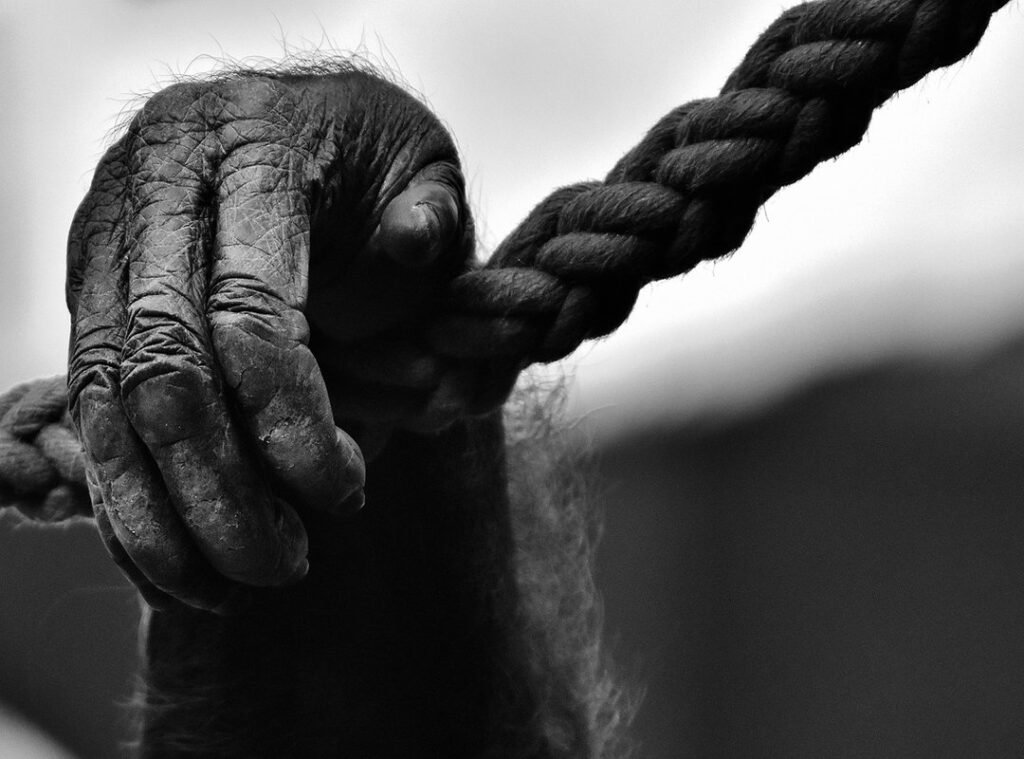
I’ve seen it a thousand times. A monkey, with that unmistakable gesture, looking like it’s flipping the bird. It’s comical and surprising.
These images have become a staple in viral photos and videos. They’re everywhere, representing a funny form of defiance or attitude.
But what’s really going on? Is the monyet tunjuk jari tengah intentionally being offensive? Or is it just a misunderstanding?
Is this a learned behavior from humans, or something else entirely? The truth behind this gesture is more fascinating than you might think.
It reveals a lot about primate behavior, mimicry, and how we interpret animal actions through a human lens.
Decoding the Gesture: What It Really Means in the Primate World
Let’s get one thing straight. Monkeys do not have an innate understanding of the middle finger as an insult. That’s a human cultural construct.
Anthropomorphism is at play here. We tend to project human emotions and intentions onto animals, even when they don’t share our context.
So, what’s really happening when you see a monkey with its middle finger up? It could be as simple as the monkey stretching its fingers. Or it might be grooming its hand.
Sometimes, it’s just shaking something off its palm.
Primate hands are incredibly dexterous. They can perform a wide range of motions, some of which coincidentally look like human gestures. This complexity can lead to misunderstandings.
In captivity, things can get a bit more interesting. A monkey might learn to repeat the gesture through mimicry. If it sees humans doing it and gets a strong reaction—like laughter or food—it might start doing it too.
But let’s compare this to genuine primate threat displays. Those typically involve baring teeth, making loud vocalizations, or adopting an aggressive body posture. These are clear, intentional signals of aggression.
The monyet tunjuk jari tengah, on the other hand, is more likely a coincidence. It’s not a sign of disrespect or aggression; it’s just a natural movement.
Understanding these differences helps us avoid misinterpreting animal behavior. It also reminds us that while primates are intelligent, their actions often have simpler, more practical explanations.
The Science of Imitation: Why Monkeys Copy Human Actions
Mirror neurons are brain cells that fire both when an animal acts and when it observes the same action. These neurons are key to social learning and imitation, making species like macaques, capuchins, and chimpanzees excellent mimics.
Monkeys have been observed washing their food, using simple tools in novel ways, and even waving. These behaviors are often learned by watching humans. Buzzardcoding
If a monkey happens to make a gesture and receives attention or a reward, it’s more likely to repeat the action. Positive reinforcement is powerful.
This learned behavior lacks the cultural context. The monkey associates the gesture with a reaction, not with the specific meaning of insult or defiance.
It’s like a toddler repeating a curse word they overheard. They are mimicking the sound, not deploying the insult with its intended meaning.
One example is the monyet tunjuk jari tengah. This gesture, often seen as an insult, is just a mimic for the monkey. It doesn’t understand the cultural significance; it’s just copying what it sees.
| Behavior | Learned From | Context |
|---|---|---|
| Washing food | Observing humans | Mimicking cleanliness |
| Using tools | Observing humans | Solving problems |
| Waving | Observing humans | Greeting others |
Understanding these behaviors helps us appreciate the complexity of primate cognition and the role of social learning in their development.
Famous Examples and Memes in Pop Culture

You’ve probably seen the monyet tunjuk jari tengah meme. It’s that photo of a Japanese snow monkey, or macaque, in a hot spring, seemingly flipping the bird.
The context behind these photos is often misunderstood. The monkey isn’t actually giving a rude gesture. It’s likely relaxing, grooming, or reacting to the water.
These images quickly went viral, becoming widespread internet memes. They symbolize humor, rebellion, and a relatable “I’ve had enough” feeling.
The humor comes from the unexpected juxtaposition of a wild animal performing a distinctly human, and rather rude, gesture. It’s funny because it’s so out of place.
It’s worth noting, though, that the ethics of how these photos are sometimes obtained can be questionable. Provoking animals for a funny picture isn’t cool. We should always be mindful of their well-being.
Looking Beyond the Meme to Understand Animal Behavior
The main conclusion is clear: the ‘monkey middle finger’ is almost always a coincidence or a learned mimicry without understanding, not a genuine insult.
monyet tunjuk jari tengah is a phrase that highlights this misconception. It’s crucial to observe animals on their own terms. Assigning human motivations to their actions can lead to misunderstandings.
Animals communicate in complex ways. They use body language, scent, and sounds. These methods are far more nuanced than any human gesture.
While the meme is entertaining, the reality of primate intelligence and social learning is far more fascinating.
Next time you see this image, you’ll know the surprising and scientific truth behind the funny picture.
 There is a specific skill involved in explaining something clearly — one that is completely separate from actually knowing the subject. Randy Bennettacion has both. They has spent years working with latest tech news in a hands-on capacity, and an equal amount of time figuring out how to translate that experience into writing that people with different backgrounds can actually absorb and use.
Randy tends to approach complex subjects — Latest Tech News, Programming and Coding Tutorials, Emerging Technologies being good examples — by starting with what the reader already knows, then building outward from there rather than dropping them in the deep end. It sounds like a small thing. In practice it makes a significant difference in whether someone finishes the article or abandons it halfway through. They is also good at knowing when to stop — a surprisingly underrated skill. Some writers bury useful information under so many caveats and qualifications that the point disappears. Randy knows where the point is and gets there without too many detours.
The practical effect of all this is that people who read Randy's work tend to come away actually capable of doing something with it. Not just vaguely informed — actually capable. For a writer working in latest tech news, that is probably the best possible outcome, and it's the standard Randy holds they's own work to.
There is a specific skill involved in explaining something clearly — one that is completely separate from actually knowing the subject. Randy Bennettacion has both. They has spent years working with latest tech news in a hands-on capacity, and an equal amount of time figuring out how to translate that experience into writing that people with different backgrounds can actually absorb and use.
Randy tends to approach complex subjects — Latest Tech News, Programming and Coding Tutorials, Emerging Technologies being good examples — by starting with what the reader already knows, then building outward from there rather than dropping them in the deep end. It sounds like a small thing. In practice it makes a significant difference in whether someone finishes the article or abandons it halfway through. They is also good at knowing when to stop — a surprisingly underrated skill. Some writers bury useful information under so many caveats and qualifications that the point disappears. Randy knows where the point is and gets there without too many detours.
The practical effect of all this is that people who read Randy's work tend to come away actually capable of doing something with it. Not just vaguely informed — actually capable. For a writer working in latest tech news, that is probably the best possible outcome, and it's the standard Randy holds they's own work to.